

What if the tablet you pay with became the reason you remember the meal?
TIMELINE
Feb 2026 - May 2026
ROLE
Contract Product Designer
STATUS
Handed Off
TEAM
5 Designers
2 Project Managers
TOOLS
Figma
Canva
Notion
Slack
TIMELINE
Feb 2026 - May 2026
STATUS
Handed Off
TOOLS
Figma
Canva
Notion
Slack
ROLE
Contract Product Designer
TEAM
5 Designers
2 Project Managers
OVERVIEW
A photobooth built into the tablet already sitting on your table, so dinner ends with something you take home.
CONTEXT
Ziosk tablets sit on 5,000+ tables at Applebee's, Chili's, and Yard House. How can we get people to play with them.
We aimed to research GenZ behaviours to design and present features that might make the gaming experience more engaging.

MARKET ANALYSIS
We looked at 9 competitors. Every one is built for a couch, a stadium, or a group chat. None of them for the middle of a meal.
Three patterns stood out: incentives increase engagement, social visibility drives gameplay, and most importantly, an opportunity gap from competitors—accessible engagement at the table.

KEY INSIGHTS
People eat out to connect, not to compete~
We talked to 12 students who eat out most weeks. Every group pointed at the same two gaps: right after ordering, and again while waiting for the check.

PROBLEM
How might we make Ziosk's games fit the rhythm of a meal instead of interrupting it?
AI ITERATIONS
We also leaned on AI for feature ideation, using Figma Make to sketch early concepts and rough out user flows before committing to a direction.
Like any collaborator, AI is only as good as what you give it. Its output depends entirely on the prompts, context, and information you feed in. For Ziosk, we used it to synthesize our user research findings, then translated those insights into mockups for the features we each owned.

DESIGN DECISIONS
Mid-fidelity testing didn't break the flow. It broke the premise.
Client feedback raised two questions the first build never asked: does a camera pointed at a table make people uncomfortable, and does this pull heads into the screen when Ziosk games are meant to feed the conversation?
Softer theme over pixel art
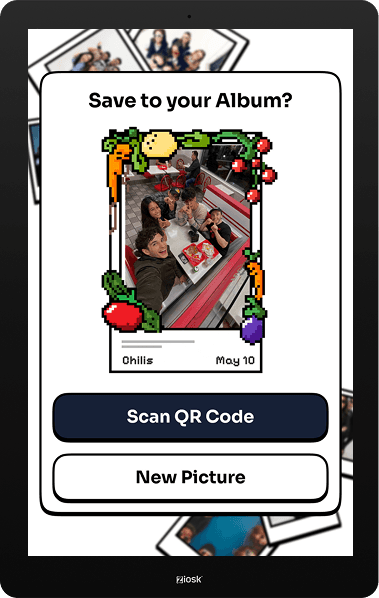
The original pixel arcade look read as a game, which is the wrong signal for a camera pointed at real people in a public dining room. Swapping to soft hand-drawn illustration made the tone innocent instead of playable, and the illustrated pair posing together models the intended use before anyone taps.


Preset frames over freehand tools
The first customization screen handed the table a full drawing toolbar, so one person became the artist while everyone else waited. Replacing it with swipeable preset frames cut customization to seconds, which lets the whole table pick together and keeps every photo on brand.


SOLUTIONS
A photobooth for the table. Strike a pose, pick a frame, scan a QR code, and everyone walks out with the picture.
Strike a mean pose!
One tap starts it, with a delay you set so everyone has time to get in frame.

Dress up your photoframe to the occasion.
Hand-drawn frames for date nights, birthdays, and holidays. Occasion first, filter second.

Save the picture to your phone
A QR code puts the photo on everyone's phone before the check lands.
OUTCOME
In development with Ziosk
We handed off the full flow and frame system to Ziosk in May 2026. The team took the work internally and is using it to shape how they improve the tablet experience, so the ideas are in play even though the feature hasn't shipped.
We didn't have access to live install data, so the concept is still unproven in a real dining room. If I were measuring it, I'd watch three things: how many tables that start the flow finish it, whether the photo actually gets saved through the QR code, and whether groups who use it once come back to it on a later visit.
Feel free to check out the full case study on our Behance.

Check out my other works!
What if the tablet you pay with became the reason you remember the meal?
TIMELINE
Feb 2026 - May 2026
ROLE
Contract Product Designer
STATUS
Handed Off
TEAM
5 Designers
2 Project Managers
TOOLS
Figma
Canva
Notion
Slack
TIMELINE
Feb 2026 - May 2026
STATUS
Handed Off
TOOLS
Figma
Canva
Notion
Slack
ROLE
Contract Product Designer
TEAM
5 Designers
2 Project Managers
OVERVIEW
A photobooth built into the tablet already sitting on your table, so dinner ends with something you take home.
CONTEXT
Ziosk tablets sit on 5,000+ tables at Applebee's, Chili's, and Yard House. How can we get people to play with them.
We aimed to research GenZ behaviours to design and present features that might make the gaming experience more engaging.
MARKET ANALYSIS
We looked at 9 competitors. Every one is built for a couch, a stadium, or a group chat. None of them for the middle of a meal.
Three patterns stood out: incentives increase engagement, social visibility drives gameplay, and most importantly, an opportunity gap from competitors—accessible engagement at the table.
KEY INSIGHTS
People eat out to connect, not to compete~
We talked to 12 students who eat out most weeks. Every group pointed at the same two gaps: right after ordering, and again while waiting for the check.
PROBLEM
How might we make Ziosk's games fit the rhythm of a meal instead of interrupting it?
AI ITERATIONS
We also leaned on AI for feature ideation, using Figma Make to sketch early concepts and rough out user flows before committing to a direction.
Like any collaborator, AI is only as good as what you give it. Its output depends entirely on the prompts, context, and information you feed in. For Ziosk, we used it to synthesize our user research findings, then translated those insights into mockups for the features we each owned.
DESIGN DECISIONS
Mid-fidelity testing didn't break the flow. It broke the premise.
Client feedback raised two questions the first build never asked: does a camera pointed at a table make people uncomfortable, and does this pull heads into the screen when Ziosk games are meant to feed the conversation?
Softer theme over pixel art
The original pixel arcade look read as a game, which is the wrong signal for a camera pointed at real people in a public dining room. Swapping to soft hand-drawn illustration made the tone innocent instead of playable, and the illustrated pair posing together models the intended use before anyone taps.
Preset frames over freehand tools
The first customization screen handed the table a full drawing toolbar, so one person became the artist while everyone else waited. Replacing it with swipeable preset frames cut customization to seconds, which lets the whole table pick together and keeps every photo on brand.
SOLUTIONS
A photobooth for the table. Strike a pose, pick a frame, scan a QR code, and everyone walks out with the picture.
Strike a mean pose!
One tap starts it, with a delay you set so everyone has time to get in frame.
Dress up your photoframe to the occasion.
Hand-drawn frames for date nights, birthdays, and holidays. Occasion first, filter second.
Save the picture to your phone
A QR code puts the photo on everyone's phone before the check lands.
OUTCOME
In development with Ziosk
We handed off the full flow and frame system to Ziosk in May 2026. The team took the work internally and is using it to shape how they improve the tablet experience, so the ideas are in play even though the feature hasn't shipped.
We didn't have access to live install data, so the concept is still unproven in a real dining room. If I were measuring it, I'd watch three things: how many tables that start the flow finish it, whether the photo actually gets saved through the QR code, and whether groups who use it once come back to it on a later visit.
Feel free to check out the full case study on our Behance.
Check out my other works!
Doodled with love @ Jerry Chen 2026